
SNF Billing Services: How to Choose an Outsourced Billing Partner for Skilled Nursing and Rehab
The right SNF billing services partner understands post-acute reimbursement, not just claim submission. Choose a team with proven experience in Medicare’s skilled nursing payment model, consolidated billing, Medicare Advantage authorizations and Medicaid eligibility. Then get four things in writing: who runs your triple check, how they work in your EHR, which KPIs they commit to, and what reporting you will see.
Key takeaways
- SNF billing errors usually start in documentation, so your billing partner has to work with nursing and therapy, not just submit claims.
- Use the free Excel scorecard below to compare vendors on the same ten questions.
- Put KPIs and remedies in the contract, measured against your own baseline.
In its latest breakdown by provider type, CMS estimated that 11.8% of Medicare payments to skilled nursing facilities were improper, about $4.3 billion, on claims from July 2023 to June 2024 (CMS). Most of the top causes were documentation gaps, such as missing orders and assessments that did not support the payment level billed. The problem is not shrinking overall: Medicare’s fee-for-service improper payment rate rose to 7.32% in fiscal 2026 (CMS). A vendor that only pushes claims out the door cannot fix documentation.
Why is skilled nursing facility billing harder than physician billing?
Skilled nursing facility billing ties payment to the resident’s clinical assessment. Under Medicare’s Patient Driven Payment Model (PDPM), the MDS assessment sets the payment code on the claim. A weak assessment becomes a payment error.
Consolidated billing adds a second layer. During a covered Part A stay, the facility bills Medicare for nearly every service the resident receives, and outside suppliers bill the SNF instead of Medicare (CMS). Someone in your business office has to catch and pay those invoices.
Then there is the payer mix. In the median freestanding SNF, traditional Medicare covered just 8% of facility days in 2024, and Medicaid pays for most long-term care (MedPAC). Add Medicare Advantage, which now covers 55% of eligible Medicare beneficiaries (KFF), and a growing share of short-term stays depend on plan approvals and concurrent reviews.
Signs it is time to outsource SNF billing
- A/R over 90 days keeps growing, especially Medicaid pending and Medicare Advantage balances.
- Only one person knows how the monthly triple check works.
- Denials for missing authorizations are rising.
- Stays sit unbilled after month end.
One of these is manageable. Two or more usually means the business office is stretched too thin for its payer mix.
What should SNF billing services include?
Good SNF billing services cover the whole cycle, from admission to cash posting:
- At admission: insurance checks, Medicare Advantage approvals and Medicaid applications.
- During the stay: PDPM accuracy with your MDS coordinator, the monthly triple check, and outside vendor invoices.
- After billing: claims, payment posting, denials and appeals, audit requests and A/R follow-up.
If a proposal covers only the last line, the hardest work stays with your team.
Ten questions to ask an SNF billing company
Ask every vendor the same ten questions and score the answers side by side. Vague answers on the triple check, consolidated billing or contract KPIs are the clearest warning signs.
- How many SNF and rehab clients do you bill for today, in our state?
- Who runs our triple check, and what does it cover?
- How do you track consolidated billing invoices?
- What happens when a Medicare Advantage plan cuts a stay short?
- Who follows up on Medicaid pending residents, and how often?
- Do you work inside our EHR, or do you need exports?
- Are audit requests and appeals included in the fee?
- Which KPIs go into the contract, and what happens if you miss them?
- Who is our day-to-day contact, and who do we escalate to?
- Can you share a current SOC 2 Type II report?
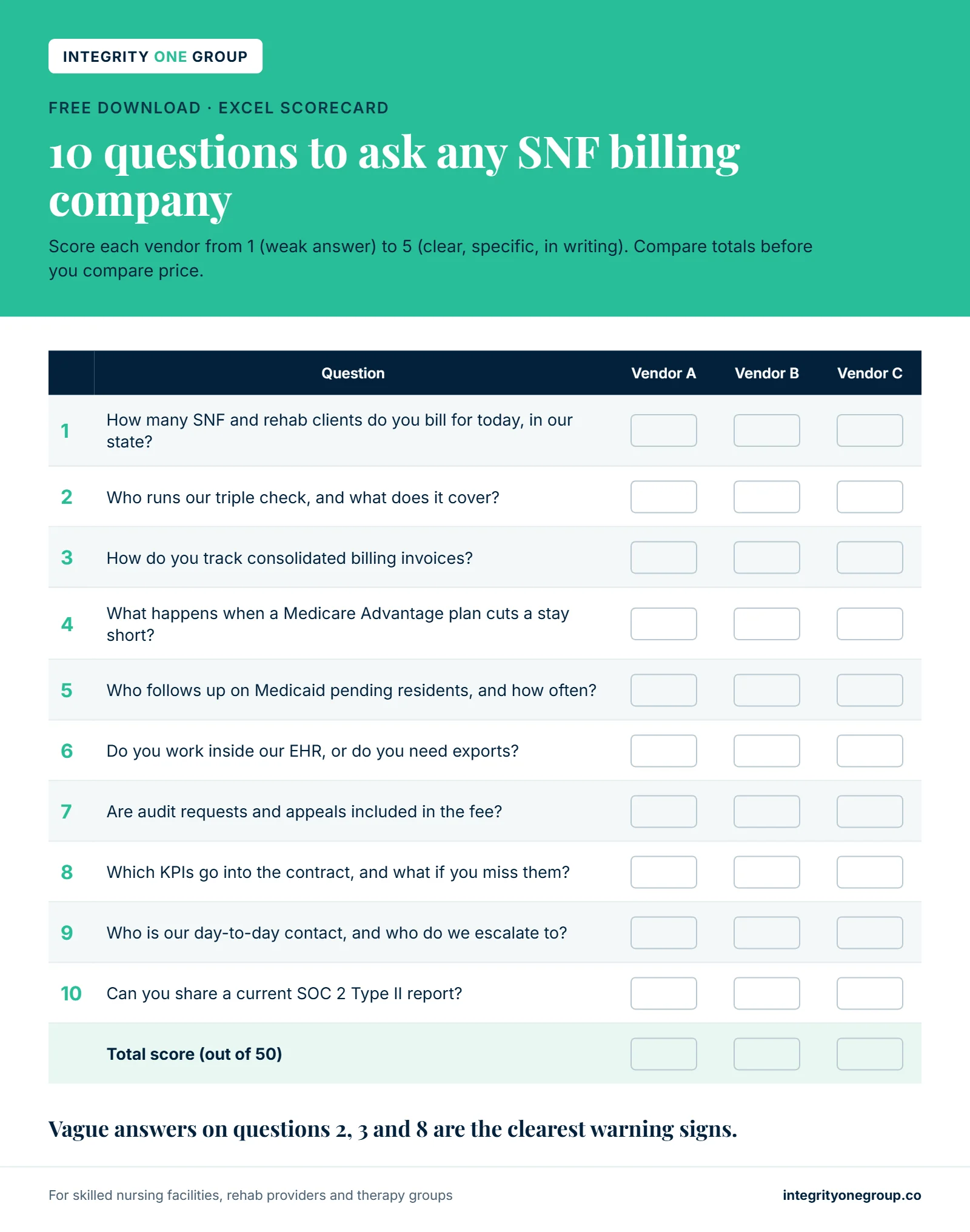
Download the SNF billing vendor scorecard (Excel), free and with no sign-up. Type in up to three vendor names, pick a score from 1 to 5 for each answer, and the sheet totals, ranks and flags weak answers for you. Each question also shows what a strong answer sounds like. For general contract terms, see our 12 questions to ask before signing a medical billing contract.
What KPIs belong in an SNF billing contract?
An SNF billing contract should name each KPI, your starting baseline and the vendor’s target. Set targets from your own last six to twelve months of data, split by payer, so progress is measured against your facility, not an industry average.
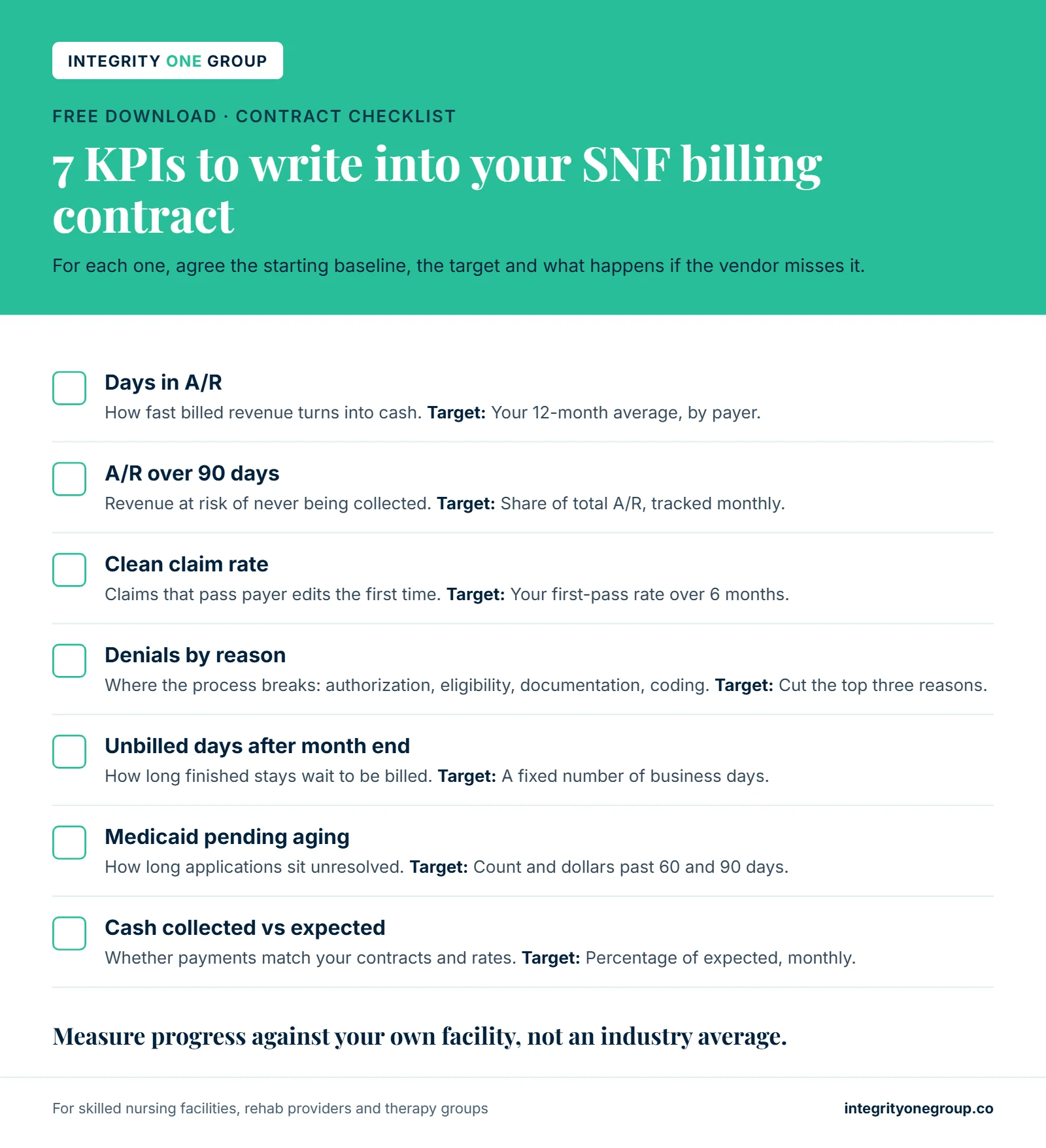
The same Excel file has a Contract KPIs tab where you can record your baseline, each vendor’s target and the remedy if it is missed. It covers days in A/R, A/R over 90 days, clean claim rate, denials by reason, unbilled days after month end, Medicaid pending aging, and cash collected against expected.
How are SNF billing services priced?
Most vendors charge in one of three ways. A percentage of collections ties the fee to results, but check whether old A/R and Medicaid recovery cost extra. A flat or per-bed fee is predictable, but ask what changes when census moves. A dedicated staff model gives you named billers, so ask who covers absences and checks quality.
Red flags when choosing an SNF billing company
- No SNF or rehab references.
- No clear owner for the triple check.
- No KPIs or remedies in the contract.
- You would have to leave your EHR.
- A long contract with no exit clause or data return terms.
What results should you expect? A rehab provider case study
A rehabilitation provider that treats about 15,000 patients a year across 12 locations partnered with Integrity One Group’s revenue cycle team. Days in A/R fell 47.5%, from 40 to 21. The provider now collects 94% of expected revenue within 60 days and holds a 98% authorization approval rate.
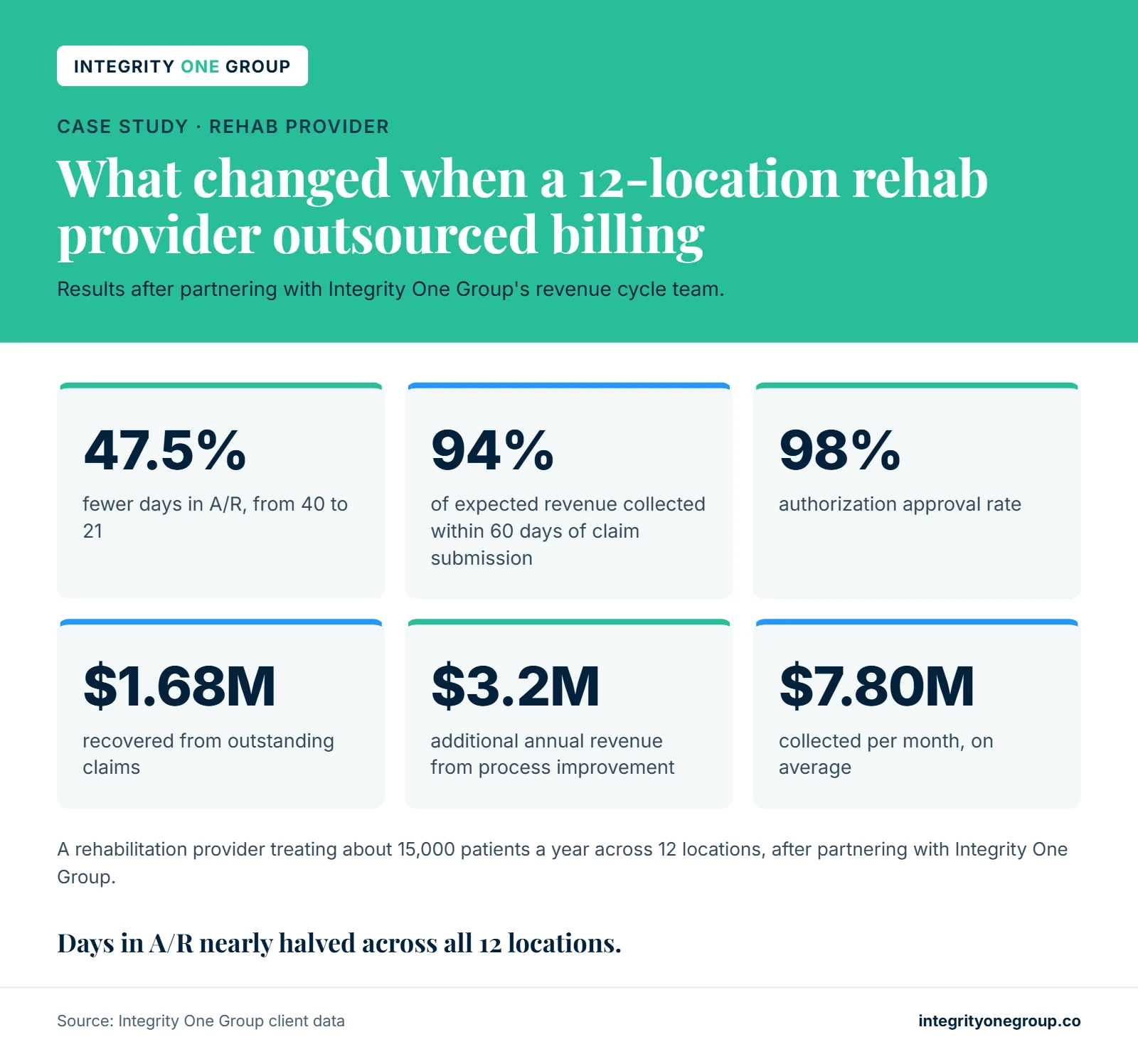
That authorization rate matters in post-acute care. A 2024 U.S. Senate subcommittee staff report found that two of the largest Medicare Advantage plans denied post-acute prior authorization requests at roughly three times their overall denial rate in 2022 (U.S. Senate PSI).
Choose the SNF billing partner that owns the hard parts
Before you sign, get three things in writing: who runs your triple check, which KPIs the vendor commits to, and what happens when a target is missed. Download the free Excel scorecard to compare vendors side by side.
How Integrity One Group supports skilled nursing and rehab providers
Integrity One Group is a healthcare operations partner serving more than 825 providers across 30+ states, including nursing care facilities and rehabilitation services, with revenue cycle management, virtual staffing and care management. Its teams integrate with 60+ EHRs and work under HIPAA and SOC 2 Type II controls.
CMS finalized a 2.4% SNF payment update for fiscal year 2027 (CMS), but that increase only reaches you if the claim is right. Contact Integrity One Group to review your payer mix, A/R and triple check. You will know where revenue is slipping, whether or not you outsource.

SNF billing services cover the post-acute revenue cycle from admission to payment: insurance checks, Medicare Advantage approvals, Medicaid pending follow-up, PDPM coordination, the monthly triple check, consolidated billing, claims, payment posting, denials, appeals and A/R follow-up, with monthly reporting against agreed KPIs.
Outsourced SNF billing is usually priced as a percentage of collections, a flat or per-bed monthly fee, or a dedicated-staff fee. Compare total cost, including what each proposal excludes, such as old A/R, Medicaid applications or private pay collections.
SNF consolidated billing is the Medicare rule that makes a skilled nursing facility responsible for billing Medicare for nearly all services a resident receives during a covered Part A stay. Outside suppliers bill the SNF, and a short list of services is excluded (CMS).
A triple check is a monthly pre-billing review in which billing, nursing and therapy compare each Medicare claim against the MDS assessment, physician orders and therapy documentation. It catches documentation and coding errors before the claim goes out.
An SNF should consider outsourcing billing when A/R over 90 days keeps growing, the triple check depends on one person, or Medicare Advantage and Medicaid pending balances are hard to control. In-house billing works with stable, trained staff. Outsourcing adds depth and coverage for turnover.