
Medical Billing for a New Practice: What to Set Up Before the First Patient
Opening a medical practice takes a tremendous amount of work. There is the space, equipment, staffing, technology and, of course, getting patients on the schedule. Billing can look ready because the software is installed and someone has been hired to submit claims, but there are details that need to be worked through before the first visit. Who is approved with each payer? Is the provider linked to the new group? Who checks authorizations? How will the practice know that every completed visit reached billing?
Over the years, I have seen how quickly a small gap becomes a larger problem when the schedule gets busy. A provider enrollment issue can affect weeks of claims. An incomplete template can leave the same information missing from every note. A misunderstanding about responsibilities can leave completed services unbilled. This is why I encourage new practices to work through the entire process, from the first appointment being scheduled to the payment being received, before opening.
Confirm enrollment before relying on payment
Credentialing, enrollment and contracting are often discussed as though they mean the same thing. They do not.
An application submitted is not an approval. A provider who participated with a payer at a previous practice is not necessarily participating under the new practice’s tax ID.
Keep a tracker for each provider, payer and location that includes:
- The legal practice name, tax ID and applicable group NPI.
- The provider’s individual NPI, taxonomy and license information.
- Individual and group enrollment status.
- Required group affiliations or Medicare reassignment arrangements.
- Approved practice locations.
- Network status and effective dates.
- Written approvals and outstanding items.
Medicare has separate enrollment processes for individual practitioners and groups, including reassignment of billing rights when applicable. Make sure those arrangements support how the practice will bill. Keep the approval letters. Confirm the effective dates. Do not build your opening schedule around an assumption that enrollment will be completed or backdated.
If nurse practitioners or physician assistants will be seeing patients, work through their billing arrangements as well. Pending credentialing does not, by itself, allow their services to be billed under a physician. Any such billing must meet the applicable payer’s requirements and be supported by the care provided and documented.
Make sure the system reflects the practice
The billing system needs to be built around the services the practice plans to provide. An office visit, an injection, a diagnostic test and a procedure may have different requirements. The setup should account for those differences before staff begin entering charges.
Review the provider and location records, billing and rendering provider fields, place of service, procedure and diagnosis codes, modifiers, units and diagnosis linkage. Confirm that referring or ordering provider information can be captured when required.
Confirm clearinghouse connections, payer identifiers, and electronic payment and remittance enrollment.
The practice’s charge amounts and contracted allowances should be clearly distinguished. Staff need that information to explain estimated patient responsibility and review payments accurately.
Walk through sample encounters. Look at the claim that comes out of the system. Does it identify the correct provider, group, location and service? The information can look correct on the screen and still produce an incorrect claim.
Define what “insurance verified” means
An active insurance policy is only the starting point. Before the visit, staff should confirm the patient’s specific plan, whether the provider and location participate, and whether the planned service requires a referral or authorization.
The process should address:
- Eligibility for the date of service.
- The correct plan and product.
- Provider and location network status.
- Relevant benefits and patient cost sharing.
- Referral and authorization requirements.
- Coordination of benefits and secondary coverage.
Document when verification is completed and retain the supporting response or reference information. An authorization also needs to match the service being provided. Check the provider, location, dates and units where applicable. Having an authorization number does not help if it covers a different location or procedure. These checks do not guarantee payment, but they help the practice identify issues while there is still time to address them.
Give providers clear documentation expectations
Before the first patient, providers should understand what needs to be in the record and when it needs to be completed. The documentation should explain why the patient was seen, what was addressed, what decisions were made, and what services were performed. It should also identify who performed the service.
Set expectations for:
- Completing and signing records.
- Supporting the service and level billed.
- Linking diagnoses to tests, procedures and other services.
- Documenting time when the billing method requires it.
- Completing procedure notes and diagnostic interpretations.
- Documenting supervision or shared services when applicable.
- Making corrections, late entries and addenda transparently.
Review templates before putting them into use. A template should help the provider document the encounter. It should not insert findings, time, or services that did not occur.
One issue I see often is a diagnosis listed in the chart without an explanation connecting it to the service ordered. A diagnosis on the problem list does not, by itself, explain why a test was needed that day. The record should make that connection clear. The billing team should not have to guess what the provider intended. There also needs to be a process for returning documentation questions to the provider and holding charges when required information is missing.
Account for every completed service
Missing charges will not show up on a denial report. They were never submitted. Decide who enters charges, who reviews them, and who reconciles completed encounters against billing activity. For every completed visit, the practice should be able to determine whether the documentation is complete, whether charges were entered, and whether the claim was submitted or is being held.
Include procedures, diagnostic testing, and services performed outside the main office when applicable. Unsigned notes, missing reports and incomplete diagnosis linkage need a person responsible for follow-up. A list of pending items is useful only if someone is working on it.
This is especially important when the office and billing team are separated. Both may be doing their assigned work while a task between them has no owner. Every step needs someone responsible for making sure it is completed.
Explain financial policies before there is a balance
Patients should understand the practice’s financial policies before receiving a statement. Address copayments, deductibles, coinsurance, self-pay charges, payment plans, refunds, credit balances and any permitted cancellation fees. Review the policies against payer contracts and applicable requirements. Train staff on what they can collect, what needs review and how to explain an estimate. An estimated amount should not be presented as a guaranteed final balance.
The practice also needs a Good Faith Estimate process for uninsured patients and patients choosing not to use insurance when federal requirements apply. A general financial consent form does not replace a required estimate. A patient’s signature also does not override a payer contract or applicable billing protections. Before collecting payment for noncovered or out-of-network services, confirm what notices are required and whether the balance can be billed to the patient.
Put privacy and security into the workflow
Patient information starts moving through the practice before the first appointment. Scheduling, registration and insurance verification all involve information that needs protection.
For a HIPAA-covered practice, complete a security risk analysis and address the risks identified. Establish individual user accounts, appropriate access permissions, secure record-sharing methods, staff training, backup procedures and a way to report incidents.
Decide how access will be changed when someone’s responsibilities change and removed when someone leaves. Have the required privacy notices and record-access procedures ready.
Review vendor relationships, including the billing company, and put business associate agreements in place where required.
Purchasing software described as “HIPAA compliant” does not complete the practice’s responsibilities. The way people use and access that software matters.
Make it clear who handles questions and corrections
Staff need someone they can go to when a claim does not look right. Name the person responsible for coordinating billing compliance. Put procedures in writing and train staff on the situations they are likely to encounter.
What happens when documentation does not support a charge? Who reviews an uncertain modifier? Who investigates a possible overpayment? Who responds when a patient questions a bill?
Those questions should have answers before the practice gets busy. If billing is outsourced, establish what the billing company handles, what the office handles, and what must come back to the provider. Make sure the practice can access reports and understand unresolved issues.
Outsourcing the work still requires practice oversight.
Plan for what happens after submission
A submitted claim is not a paid claim. Someone needs to review clearinghouse rejections, payer acknowledgments, denials, unpaid claims and requests for records. Filing and appeal deadlines need to be tracked.
Payment posting should include a review of expected allowances, contractual adjustments and patient responsibility. Establish a process for reviewing credit balances and investigating and returning overpayments when required.
A denial should not automatically become a patient’s balance. First, determine why the claim was denied and whether patient billing is permitted. The practice needs to know both what is unpaid and why.
Review the first claims early
Do not wait several months to find out whether the setup is working. Review an initial sample across providers, payers, and service types. Compare the claim with the documentation. Check the rendering provider, location, coding, modifiers, and diagnosis linkage, then review the payer’s response. Look for completed visits without charges, unsigned records, held claims, repeated rejections, and payments that differ from expectations.
If a pattern appears, address it with the people involved. Give them specific examples and explain what needs to be changed. Then check that the correction is working. It is much easier to fix a process while the volume is small.
Before the first patient
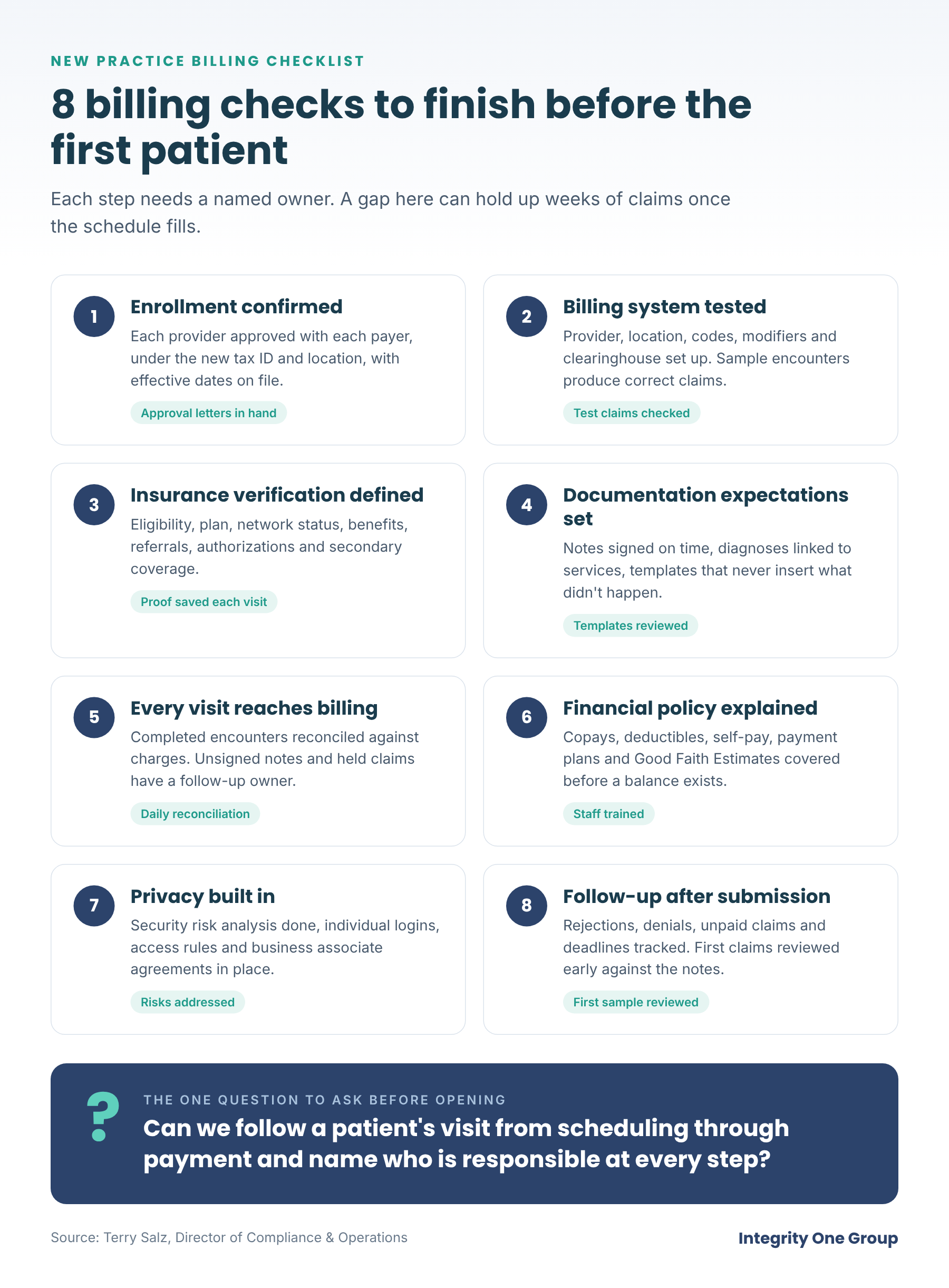
I would ask one question: Can we follow a patient’s visit from scheduling through payment and identify who is responsible at every step?
If the answer is unclear, work through those gaps before opening. There will always be questions as a new practice gets started. Enrollment, documentation expectations, charge capture, patient financial policies, and follow-up responsibilities should already be established.
You have worked hard to open your doors. Give the billing process the same attention you have given the space, staffing and patient care. Know who is responsible, confirm that the setup works and address questions before they become repeated problems.
The first day of patient care is also the first day of revenue responsibility. A prepared billing office understands the weight of both.
A successful opening starts before the first appointment. When every billing step has an owner and the process is tested early, practices can avoid small gaps becoming costly problems.


Credentialing verifies a provider's qualifications. Enrollment sets the provider up to bill a payer under a specific tax ID, group and location. Contracting sets the network status and agreed rates. A practice needs all three confirmed before relying on payment from that payer.
Not automatically. Participation is tied to the tax ID, group and location. A provider who was in-network at a previous practice still needs to be enrolled and linked to the new group before claims are paid under it.
Pending credentialing does not, by itself, allow it. Any such billing must meet that payer's specific requirements and be supported by the care provided and documented.
At minimum, verification should cover eligibility for the date of service, the correct plan and product, provider and location network status, benefits and cost sharing, referral and authorization requirements, and secondary coverage. Staff should also save proof of the check.
Within the first few weeks, not months. Review a sample across providers, payers and service types, and compare each claim with the documentation and the payer's response. Problems are much easier to fix while volume is small.